
IMPORTANT – About My Home – Clutter Porn

Well, maybe not that important. Just a mini rant about the overuse of the word important, along with its close cousin, urgent, in communications and especially on mail items. They seems to be cluttering half of the envelopes that arrive in my mailbox, yet their contents are rarely important to anybody except the sender.

Why do mail marketers and others continue to use this tired old trick? I suppose that’s rhetorical — they use it because it works. After all, even though we know the odds are it isn’t important, and may be of no interest to us at all, we don’t dare throw it away unopened just in case it actually is important.

More Tricks

Sure, sometimes you can tell from the return address who it’s from, but sometimes there’s no name; just an address. Or worse yet, the return address is misleading. Bank Of America (or its “marketing partners” – euphemism for “companies we sold your name and address to”) sends all sorts of things in essentially identical envelopes, all with the bank’s return address. Usually it’s an offer for some sort of insurance, or trying to get me to apply for some sort of loan or another, but I am forced to open each and every one and give its contents at least a cursory glance, lest I discard my statement or other legitimate communication regarding my account.

OK, now that I have that mini-rant out  of my system, and just to show you my headline isn’t totally bogus, let’s move on to something that, while it might not be too important in the overall scheme of things, you might enjoy.

About My Home

With all that describing of different kinds of RVs in my last post, I didn’t even tell you what I live in. My home is a 1979  Georgie Boy Cruise Master  CM20RB. It is a 20-foot class C motorhome. Interior space  is 18 feet long by 7 feet wide, or 126 square feet.  Here’s the floor plan:

Here’s what it looks like on the inside…
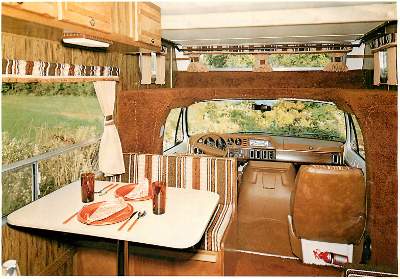
…or at least what the one in this brochure did when it was new:

If you’d like to learn more, or are just into 70’s advertising or shag carpeting, you can click the brochure cover for an eight-page PDF.

Ahhh, but what does it look like now, 32 years later, you ask? Time for…

Clutter Porn!

I know that at least one of my readers (Hi Tanja!) has been patiently waiting for me to post some photos of my clutter. While I’m not quite ready to offer a full portfolio yet, I’ll dip my toe in the water with this small offering:
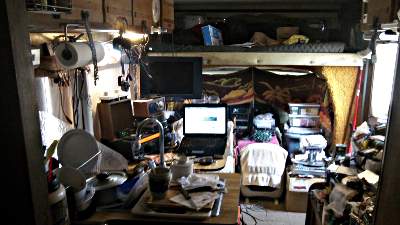
As you can see, I still have my work cut out for me. In my defense, pretty much everything I own is in here, in 126 square feet. I’m still plugging away at it, and I’ll get there eventually (and post more photos, too).

Oh, and here’s what the outside looks like:

Yeah, even the outside is cluttered, but the stuff on top of the table and the boxes and pile near the rear wheels are stuff to be sold or donated, so it’s not quite as bad as it looks. Why’s the hood open? Mechanical trouble? Naw, it’s just open to discourage the packrats (the 4-legged kind) from nesting in there. They’ll make a mess and chew through hoses and wires, too.

What Do You Think?

Are “important” and “urgent” overused? Is 126 square feet too big? too small? just right? Want more clutter porn? Comments are always open.

Exploring RV Living – What’s In A Name?

(This post is part of a series. If you’re new to my blog or this is the first you’ve seen of this series, you might look at the introduction first.)

I live in an RV, but just what does that mean? “RV” is actually an abbreviation for Recreational Vehicle, although many of us who live in one full-time prefer to think it really stands for Residence or Residential Vehicle. Elsewhere in the world “recreational vehicle” refers to the ruggedized, often four-wheel drive vehicle that we call an SUV, or Sport Utility Vehicle, but here in North America, an RV  is a motor vehicle or trailer having at least the basic necessary amenities of a home. For licensing, registration, and insurance purposes, to qualify as an RV a unit must include, at minimum, sleeping, cooking, and toilet facilities. In most other parts of the world a similar unit would be called either a camper van, if motorized, or a caravan, if towed. It is self-contained and self-sufficient, enabling all on-board systems to be functional without external connections for periods of days, weeks, or even months.

Now that we’ve defined the umbrella term RV, let’s take a look at all the different types of RVs. We can start by separating the lot into two groups: drivable and towable.

Drivable Dwellings

Drivable RVs are called motorhomes. They have an engine, a steering wheel, and a driver’s seat. They are fully self-contained motor vehicles that are also fully functional residences. Or, as Homer Simpson says, “It’s not just a motorhome — it’s a car you can go to the bathroom in!” They have the advantage of being a single vehicle that does it all. The disadvantage is that most motorhomes are too cumbersome and fuel inefficient to use as daily drivers. Most motorhome dwellers either tow a small car behind the motorhome or carry a bicycle, scooter, or small motorcycle for everyday local transportation.

Class A motorhomes are the largest of the motorhomes, built on a truck or bus chassis. They resemble a bus in that they usually have a flat front and boxy shape to them. The driver’s seat is obviously located at the front of the cabin, but there is no separate cab.

Bus conversions are a subset of class A motorhomes. A transit or school bus is converted, either commercially or DIY, into a custom motorhome. Commercially manufactured bus conversions usually start with a new empty bus shell, while DIY conversions are often made from retired commercial or school buses. There is plenty of room for creativity and originality in DIY conversions – many are as much works of art as they are homes on wheels.

Class B motorhomes are built inside a modified standard full-size van, and are sometimes called camper vans. From the outside it might be difficult to tell a class B motorhome from a regular van – the exterior differences include a raised roof (so that one may comfortably stand erect inside) and various vents and connections belonging to appliances and subsystems but may go unnoticed to the untrained eye. One of the biggest advantages of the class B van is that it is small and nimble enough for regular driving, so it could easily be your only vehicle. It’s also pretty stealthy, working well for urban camping.

Class C motorhomes are built upon a “cutaway” van or truck chassis. They retain the truck chassis’ cab, complete with its doors, windows, dashboard, and driver’s seat and controls. From the outside they are easily recognized by the telltale “cab over” portion of the coach which overhangs the cab.

Draggable Domiciles

Towable RVs — trailers — have the advantage of being able to un-hitch and use the tow vehicle for local transportation without having to carry your whole house around as you would with a motorhome. Trailers also come in a variety of styles.

Travel trailers are perhaps the most common trailers. They are towed by a bumper- or frame-mounted ball type hitch. They are sometimes also called bumper-pull trailers. For all but the smallest and lightest travel trailers, you’ll need a full-size pickup truck or large SUV to tow it with.

Other bumper-pull trailers include popups, sometimes called tent trailers, which are low profile when closed for travel, but “pop up” into a soft sided tent-like structure for camping, as well as “teardrop” and other hard-sided micro trailers.  The advantage to these lightweight trailers is that they can be easily towed by almost any vehicle, including a compact car or mini pickup.

Fifth-wheel trailers connect to the tow vehicle using a fifth-wheel hitch and kingpin system, just like a semi-trailer on a big truck. The fifth-wheel hitch is installed in the bed of a pickup truck, though some owners of very large fifth-wheel trailers prefer to use a semi tractor instead of a pickup truck as a tow vehicle. The big advantage of a fifth wheel trailer is size and carrying capacity. If you want the most living space possible and less risk of overloading it, a fifth wheel would be a good choice. In addition to the extra towing capacity, a fifth wheel offers improved handling and maneuverability over a travel trailer’s bumper pull system.

Pickup Campers

There’s one more type of RV that’s worthy of mention but is neither motorized nor towable. The pickup camper is a complete dwelling unit that slides into the bed of a pickup truck. This combination offers some of the convenience of a tiny motorhome with some of the advantages of a trailer. At the campsite, the camper can be supported by jacks and the pickup truck can be driven out from under it, so it may be driven as needed without having to break camp.

That’s Not An RV!

The Mobile Home – while it is a house on wheels, it is usually mobile in name only. They are difficult to move, and therefore it is rarely done. Also, they are not fully self-contained – they need to be connected to water, waste, and electric infrastructure. House Trailer is another name for a mobile home.

Your Turn

Did I miss something? Have any questions? Comments are open!

Decluttering Decisions – The “Lost Or Stolen” Test

(For those of you eagerly awaiting the next installment of “Exploring RV Living,” it will be coming later this week. If you haven’t done so yet, subscribe via email or RSS to make sure you don’t miss it. Links are over in the right-hand column, below my mug shot.)

I’ve always been a thorough researcher when it comes to major purchases, and have read my share of online product reviews. While trying to come up with a relatively easy rule to help me decide what to keep and what to eliminate in my decluttering efforts, I remembered a question I’ve seen asked by at least one review site, and is frequently volunteered by reviewers on other sites, especially musician’s gear sites: “Would you buy it again if it was lost or stolen?” In the context of a product review, it’s an excellent question. If something is so useful or desirable that you couldn’t be without it, that’s about as good as a personal recommendation can get.

Not Just For Reviews

It turns out that the “lost or stolen” question makes a really good test during decluttering. What we would do in the event of the sudden disappearance of an item is a good gauge of that item’s actual necessity and value to us. The low hanging fruit (or maybe the fruit that’s already fallen from the tree?) is quickly eliminated by asking ourselves “If this was lost or stolen, would I even notice?”

What Would You Do?

Where “lost or stolen” really shines, though, is after the first few rounds, after the obvious fluff has already been eliminated. Now the decision process is more challenging. We need to separate the “that’s really nice” stuff from the “I really need that” stuff. As you look at an item, ask yourself “If this were lost or stolen (or broken beyond repair) would I immediately run out and buy another one just like it?” If you can honestly answer “yes” to that question, then the item is probably a keeper. If, on the other hand, you answered that you’d figure out how to get on without it, then you probably don’t need it. If your answer is “I’d have to replace it, but probably not with one like it,” that’s a sign that it serves a needed purpose, but is probably not a good match for your current lifestyle. In that case it might be worth considering replacing the less-than-ideal item with something more suitable. No hurry, though — you can wait until it needs replacing anyway.

Terrific Test

While this isn’t the answer to all decluttering dilemmas, such as what to do with sentimental and decorative things, the “lost or stolen” test is a great tool for making decisions regarding practical things. Can you think of any other  simple tests to help with decluttering decisions? What have you found that helps you separate the wheat from the chaff? Comments are open — don’t be shy!

Exploring RV Living – Introduction

Many of you probably already know, or have deduced, that I live full-time in my RV. A small motorhome, to be exact. Somewhere back in my early archives I wrote about some of the considerations that led me to this lifestyle choice, but I figured it was time to revisit the whole concept. I’d also like to explore how it has been working out, now that I’ve been doing it for several years, and share with the curious just what RV living on a full-time basis is like.

About The Headline

While looking at my blog stats, I’ve noticed that I often get search hits with variations of “RV living” in them, yet  “RV lifestyle” or “RV full-timing” almost never appear. While the latter terms are common among the RV community, “RV living” or “living in an RV” are what I guess most people call it. I hope my decision to go with a title that favors common usage over insider jargon helps folks interested in this lifestyle to find this series. I’ll be offering a combination of general information and specific details of my own personal home and lifestyle.

Did You Say Series?

I’ve decided to make this a series for a few reasons. There’s way too much to cover for a single blog post. It would end up being far too long while still skimping on details. By breaking it up into a series of posts I can give each subtopic the attention and space it deserves.

Each reader may not be equally interested in each facet of RV living. Some may be more interested in the technical details of the various subsystems, others in the details of travel and locational possibilities, and still others in the social and community aspects of the lifestyle.

There will even be topics of interest to folks who could care less about the RV lifestyle, but might want to learn about off-grid living, strategies for living in tiny spaces, and location independence, all of which are parts of RV living.

The series format will allow readers to pick and choose what interests them, while allowing me to sufficiently elaborate on each topic. It will help keep follow-up discussions in the comments section organized too.

Topics I Plan To Cover

  • What’s in a name? – RV, camper, motorhome, pop-up, caravan, fifth wheel, house trailer, travel trailer, mobile home, van and bus conversions; what do they all mean and what’s the difference?
  • Camping vs. living – The similarities and differences between RV camping and full-time RV living.
  • Home is where I park it – Campgrounds, RV parks, private property, boondocking, and more.
  • All the comforts of home – Lights, running water, flush toilet, and a complete kitchen, even in the middle of nowhere.
  • Staying connected – Wireless telephone, internet, and HF radio keep me in touch no matter where I am.
  • That’s entertainment – Accommodating music, video, and reading libraries on-the-go in tiny places. Other entertainment options, too.
  • Similarities and differences – How is it the same as living in a tiny house or apartment, and how is it different? Exploring the unique challenges and rewards.
  • Environmental considerations – Many people think of an RV as a big, gas-guzzling road-hog, but is it really that bad? It makes for a very eco-friendly dwelling when it isn’t rolling down the road.
  • Is it expensive? – You can spend a fortune if you want, yet it can be surprisingly affordable, especially if you are handy and creative. Ongoing expenses can be very minimal.
  • Is it for you? – It may not be for everybody, but if you have a sense of adventure and a taste for unconventional living, it might be for you. Why I chose to try it and why I’m still doing it.

You Can Help

I’m sure I’ve missed something. Those are only the things I’ve thought you might be interested in. Please jump in down in the comment section and let me know what interests you and what you want to read about. Nothing is carved in stone – this series can go where you want it to.

Also, would you prefer that I concentrate my writing efforts exclusively on this series, until I’ve exhausted the topic, or would you rather I do, say,  one “Exploring RV Living” post plus an unrelated second post each week? Your opinion is important to me.

Swamp Cooling In The Desert

The Phoenix area is once again under an Excessive Heat Advisory with temperatures expected to be over 115 degrees through the weekend. It’s already 110° here this morning and it isn’t even noon yet. Earlier this week I wrote about how my swamp cooler was successfully taming the intense desert heat. It just occurred to me that some of you may not be familiar with evaporative coolers, and some of you who might know something about them may have some misconceptions. Here’s what my cooler looks like:

It’s not much to look at, is it? This particular cooler was purchased brand new about five years ago, yet it differs very little from the early twentieth century design upon which it is based.

Behind the louvers are excelsior pads which are kept wet with water. A blower inside the cabinet draws fresh air through the wet pads, and as the air passes through the pads, the water evaporates, causing the air to be cooled. The heat is literally being removed from the air as it vaporizes the water.

That’s probably technical enough for this description. If you want to learn more about how it works, this Wikipedia entry is a good start.

Swamp cooler? I thought you lived in the desert!

Well, yes. At least right now. And that’s where it works the best. Properly called an evaporative cooler, there are a few possible origins of its colloquial name. Perhaps it is because the extra humidity it adds to the air, especially during monsoon season or in an improperly vented room, can make it feel like a swamp. It could be because the air being pulled through the wet excelsior pads cools just like a breeze blowing through wet swamp vegetation. I’ve even heard it suggested that they are called swamp coolers because algae growing in a neglected or improperly maintained cooler can make it smell like a swamp, but that isn’t a problem I’ve ever  had in the 30+ years I’ve lived in the desert and used evaporative coolers.

Why use a swamp cooler?

  • Energy Efficiency – It uses 1/4 the electricity of mechanically refrigerated air conditioning.
  • Fresh Air – An evaporative cooler is constantly adding fresh air, replacing the air as frequently as once per minute.
  • Simplicity – An evaporative cooler is a very simple machine, making it economical to purchase, repair, and maintain.

Why aren’t they more common?

For one thing, they only work well in very dry climates, so you are not likely to find them outside of desert areas. Once the dew point gets into the 50’s (relative humidity over about 30%) their cooling performance is severely impaired. Here in North America you’ll find evaporative coolers in the western and southwestern United States as well as in the northern part of Mexico. They are also used in the southern part of Australia.

Even some people who live desert cities have not seen one, or at least wouldn’t recognize one if they did. And others wouldn’t be caught dead using one. I think that’s mostly due to the stigma carried by evaporative coolers as a cooling means of last resort only for the poor who can’t afford “real” air conditioning. While they certainly are inexpensive to buy and install as well as being economical to operate, I don’t understand why that should make them undesirable. I have actually seen ads for RV and mobile home space rentals that state “No evaporative coolers allowed.” So apparently the humble swamp cooler is shunned even within communities that are already considered “downscale” by much of society. It’s a shame so many people are more concerned with appearances and perceived social status than they are about economy, comfort, and environmental impact.

Freshly Pressed

I had an unexpected but pleasant surprise this past Tuesday when  one of my posts was selected to be “Freshly Pressed” — featured on the WordPress.com home page.  That was quite an honor, and the exposure drove quite a bit of fresh traffic to the site resulting in some new subscribers, too. I’d like to welcome my new readers and remind all of my readers that comments are always open on all my posts, so feel free to surf the archives and share your thoughts.

115 Degrees In The Shade

Well, folks, I have a couple more practical posts in the making, but they’re not quite ready for public consumption. On the other hand, I did say I was going to post at least once a week, and it’s been over a week now, so I thought I’d better offer up something.

About That Headline

Yes, it’s one hundred and fifteen degrees in the shade (135° in the sun!) here in the desert west of Phoenix. The absorption refrigerator is struggling to keep its contents cool. Stepping outside into the light breeze feels like walking into a giant convection oven. The forecast is for another couple days of the same, and the area is under a Heat Advisory. Summer is definitely here.

Keeping My Cool

Thanks to the Wonder of Ancient Technology known as an evaporative cooler, it is a very comfortable 82 degrees indoors, without running the air conditioner. I love my swamp cooler — not only does it save energy and money, but it also allows me to enjoy fresh cool air and open windows instead of having everything closed up and recirculating the same stale air. In another week or so I’ll unfortunately be having to do just that when the monsoon season’s increase in humidity renders the evaporative cooler ineffective. I’ll also see my electric bill triple for about three months.

Avoiding The Heat

So what have I been doing while I stay indoors avoiding the heat? Well, I’ve been pecking away at decluttering. I am amassing a boxful of small electronic bits, pieces, gadgets, and gizmos that individually would not be worth the trouble of selling, and don’t seem appropriate for thrift store donation either. Still, they’re just too darn good to throw away. I’m thinking of putting the whole boxful on eBay as a not-quite-mystery box. I’ll put up a couple photos and maybe some general descriptions of the highlights, and see what happens. If nothing else, it will be fun.

Multimedia Maintenance

I’ve also been working on my digital library as I transition from “legacy” paper and polycarbonate media to bits and bytes on a hard drive.  This is an ongoing project which I spend time on now and then when I’m in the mood. I could go into more detail sometime if you’d like to read about it. Let me know.

Clearing Clutter Pays Off

There are plenty of ways that eliminating clutter pays off. More space and less distraction, for example. But I wasn’t expecting it to pay off literally. I was going through some folded bits of paper and receipts the other day, making sure I wasn’t about to throw away anything important, and there it was folded up in an old store receipt: a twenty dollar bill! Pretty cool, huh?

In Other News

Do any of you write for content farms, or have you in the past? Are you considering writing for one to help make ends meet? You should give this NYT  Opinionator blog post and this Faster Times article a read.

Why I Don’t Carry A Smartphone

I recently did a guest post over on So Much More Life comparing multifunction and single purpose devices, using a smartphone as an example. It seems that while some commenters agreed with the general premise of the post, there was some question as to whether my example was the best one. Smartphone owners seem very happy with their devices and consider them among their most useful and important possessions. I’m guessing that they love their phones not so much because they also include a camera, GPS, and music player, but because they are  miniature computers with access to email, social networking, and the rest of the internet.

Perhaps my choice of a smartphone as an example in that post was a result of the fact that I don’t carry one, and don’t feel the need to be always connected everywhere I go. Allow me to elaborate.

I’m No Luddite

It isn’t that I dislike technology. Quite the contrary, in fact. When it comes to communications technology, I have been on the leading, and even bleeding edge most of my life. I have owned various smartphones, PDAs, tablets, pocket computers, pagers and more. There was a time when I carried multiple communication devices wherever I went. I felt that I needed to be reachable any time and any place. I was afraid of missing an important business or social opportunity.

What Changed?

Perhaps it is a bit of burnout. Been there, done that. Maybe it’s just that instant communication and constant availability have become ubiquitous; I sometimes lose interest in things if they become either too trendy or too pedestrian. Also, I think I started decluttering my social life long before I started on my physical clutter. I’ve learned that I don’t need to be instantly available to anyone at any time. I don’t need to instantly reply to email and blog comments.

Maybe it’s an age thing. When I was in my 20’s and 30’s I had more of a need to feel important and more of a fear of being left out. Now that I’m in my 50’s, I no longer feel that need for constant connectivity, and the occasional important message among the digital drivel can wait until I get to it.

Distracted Much?

Occasional distraction is one thing, but when it gets to the point that the virtual world becomes more important than the real world in front of you, it might be time to check your priorities. In a recent New York Times article, David Carr writes:

You are at a party and the person in front of you is not really listening to you. Yes, she is murmuring occasional assent to your remarks, or nodding at appropriate junctures, but for the most part she is looking beyond you, scanning in search of something or someone more compelling.

Here’s the funny part: If she is looking over your shoulder at a room full of potentially more interesting people, she is ill-mannered. If, however, she is not looking over your shoulder, but into a smartphone in her hand, she is not only well within modern social norms, but is also a wired, well-put-together person.

Add one more achievement to the digital revolution: It has made it fashionable to be rude.

I’ve learned that I don’t want to be that person. Isn’t live human interaction more important than what somebody you’ve never met just tweeted? Aren’t friends more important than “friends?” Email, Facebook, and Twitter can all wait until the meal, meeting, or conversation is over, can’t they?

I’ll admit, I was pretty obsessive about such things myself at one time. And if I still had that pocket-sized internet with me at all times now, I might still be tempted. My solution? I don’t carry that distraction and temptation with me. Even my plain phone gets turned off if I’m in a meeting or having dinner out with someone. If it’s important, they’ll leave a message or try again later.

I Don’t Need It Anymore

Back when I loved to bargain hunt, I liked having the internet with me to research pricing or other information about an item I was considering buying, but since I’m trying to cut my consumerism down to just the essentials (and those I can research from the comfort of home on a full-size screen) I don’t need that anymore. A smart phone can come in handy if you frequently find yourself with unexpected chunks of waiting time to kill. You can whip it out and catch up on email or maybe do some reading. I normally don’t find myself in that situation much anymore, but if I expect to have some waiting time — doctor’s appointment or waiting at the airport, for example — I’ll take my netbook along so I have a decent sized screen and a real keyboard to work with. Or maybe just my Kindle or a book and catch up on my reading.

There’s also the thirty dollars a month I don’t spend on a data plan ($360 a year!).

I’m Still Connected

Not carrying a smartphone is a decision I’ve made that saves me money and eliminates distractions. I don’t feel disconnected, and I don’t feel in any way left out of the online world. Instead, it allows me to choose when and how to deal with my digital communications, which is usually when I can sit down comfortably and relax, giving my email, writing, or other online activities the same undivided attention that I am able to give to my offline activities.

What do you think?

Do you carry a smartphone? Why or why not? What about your own feelings on “smartphone etiquette?”

Guest Post on So Much More Life

Gip over at So Much More Life invited me to do a guest post this past Friday. I wrote about single purpose, multi-function, and multi-tasking items. A few commenters thought my use of a smartphone as an example wasn’t the best choice, and in retrospect, they might be right. If you haven’t seen the post yet, or haven’t kept up with the comments, go read it now, and please add your own comments too.

Exceptions to Decluttering Rules?

There are two “rules” frequently cited to help with decluttering as well as to avoid re-cluttering. The first helps us decide what to get rid of by suggesting that if something hasn’t been used in X length of time (one year is the most common, but I’ve seen recommendations range from three months to two years) then you don’t need it. The other rule helps us avoid accumulation, and it is usually called the “one in, one out” rule. Let’s look at each of these rules and see if there are times we might not want to simply follow them blindly.

If You Haven’t Used It…

This rule is designed to help us decide what we don’t need. If something is stashed away in the bottom of a closet or the back of a drawer and we have not even seen it, let alone used it in months or years, what makes us think we’ll suddenly need it one day? The truth is that we probably won’t. There are exceptions, however.

Emergency!

If you drive a car, you probably carry a spare tire, a jack, and a lug wrench. If you regularly ride a bicycle any significant distance, you probably carry a patch kit or spare tube, a tool kit, and a pump. These are things we may not have used or even looked at in months or years, but we continue to carry them around because we don’t want to be stranded by the side of the road should we experience the misfortune of a flat tire. Along the same lines, we might keep first aid kits in our homes or vehicles, but hope we never need them. Ditto for fire extinguishers. Perhaps we can call this the emergency equipment exception. You can probably think of more examples, and they will vary depending on your individual situation. Just make sure you aren’t using this exception as an excuse to keep all kinds of “just in case” stuff that you probably won’t ever use and could easily re-acquire if needed.

Got Plans?

Another exception might be “I plan to use it.” This works if you have something that is already earmarked for a specific time or occasion in the future, when you know that you will use it. Don’t confuse this with “I might use it,” “I hope to use it,” or “I want to use it,” which are all excuses for keeping what we really don’t need. A variation on that exception, which I am experiencing right now, is “I plan to use it once I’ve decluttered enough room for it.” While I have to be careful that I’m not using this as a blanket excuse for keeping stuff I should be getting rid of, I think that if I have something that I honestly feel I will use and get function or pleasure from once I have the space to enjoy it, then I can at least leave it for last. Once I’ve decluttered to the point where I can comfortably accommodate the item, if I find that I am still not using it or have lost interest, then it becomes subject to expulsion.

One In, One Out

This one is very popular in the RV and Tiny House communities, where space is at a premium. It can even be expanded to “one in, two out” during active decluttering. This rule aims to maintain a static quantity of items if strictly followed. It isn’t so much subject to legitimate exceptions as it is to “creative interpretation.” We need to be sure we are following the true spirit of this rule. Getting rid of a worn out pair of socks shouldn’t justify bringing in a new TV and a game console. Yes, that’s two items in for two items out (a pair of socks), but using that kind of logic will only get you deeper into consumerist clutter. Ideally, an item goes out to make room for an equivalent but better, smaller or simpler item. Replacing several items with a single multi-function item could result in a two, three, or more-for-one trade! In any case, the items going out should be the same size or bigger than those coming in, the goal being to maintain balance or reduce clutter, not to increase it.

More Examples?

Can you think of other decluttering rules with legitimate exceptions? How about ways you or other household members try to “cheat” on the anti-clutter rules you’ve laid out?

Successful Shopping, Counterfeit Condiments

I had a successful grocery shopping trip today. I took a written shopping list with me, and stuck to it. Well, I actually did buy two additional things, but they were not impulse buys — they were needed items that I’d forgotten to write down, and was reminded when I saw them in the store. I even added them to the list before actually picking them up, just to make it official.

Lunch Before Shopping

Maybe the most noteworthy part of the outing occurred before I did my grocery shopping. Since it’s a bad idea to grocery shop on an empty stomach, especially when trying to avoid impulse buying, I decided to have lunch first. I stopped at KFC. Perhaps not the healthiest choice, but hey, I could do worse than chicken.

Honey and Butter?

The person behind the counter asked “Would you like honey and butter for your biscuit?”  “Yes, please” I replied. When it came time to eat the biscuit, I searched my tray for the honey and butter, but the closest things I could find were these:

“Honey Sauce” and “Buttery Spread” according to the packets. Click the thumbnails for a look at the fine print and you’ll see that the first three ingredients in “Honey Sauce” are high fructose corn syrup, corn syrup, and sugar. Oh, there’s a teensy bit of honey in there somewhere — “7% real honey” the package brags. As for the “Buttery Spread”, who knows what’s in it. Probably no butter. Lacking an ingredient list, the only clue is “artificially flavored”. I’m guessing  whipped vegetable oil and fake butter flavor. I suppose  fake butter is nothing new, but fake honey? I guess that’s one more reason to eat at home. At least I have honey and butter. The real kind, that comes from bees and cows.